

Designing your own home is the ultimate creative challenge—especially when you have an entire factory at your service. For Jamie Chappell, Fireclay’s VP of Brand and Product, that meant turning a compact 1970s Santa Cruz home into a real-world incubator for our latest collections. Packed with thoughtful details and an abundance of handmade craftsmanship, her newly renovated space is a study in approachable luxury built for a real, slightly muddy life.
We sat down with Jamie to talk about her design process and how her role at Fireclay helped shape this project (and how this project helped shape certain products). She draws back the curtain on her day-to-day and shares the brands she's filled her dream home with. Cozy up, preferably next to a crackling wood stove, as we get into it all.

Jamie Chappell with her dog Dolly and one of her two cats | Image: SEN Creative
Cabin Vibes in Santa Cruz
Tell us about the home and what initially drew you to the space.
I grew up in the Blue Ridge Mountains and was always drawn to the Santa Cruz Mountains because they felt like home in many ways. This led me to the town I'm in now, tucked along a string of small mountain communities in Santa Cruz. I knew that if I was going to invest in something as significant as a home, it had to have character. I also knew, as a single woman (boy, they make you tick that box a million times at closing), that I didn't want anything too big — but I did want a yard built for a big dog. I fell in love with my house because it ticked all of those boxes and, bonus, all the rooms were right where they needed to be. She was long overdue for some cosmetic updates, but her bones were good.
 Tile: 1x1 & 1x6 Ivory Gloss, Mission Antique | Cabinets: Oxford Designs (Custom)| Hardware: Plank | Design: Jamie Chappell | Image: SEN Creative
Tell us about the location. How did the surrounding landscape influence the design of your home?
This area was the birthplace of the commercial redwood industry — a boom that began in the 1850s and would eventually strip 96% of the old-growth redwoods. It also ignited a lot of conservation work, which is why my home is sandwiched between many California State Parks. Just up the hill from me is California's first state park, Big Basin. Many of the homes in this part of California were originally built as getaway cabins; some are even relics of the logging era. We're surrounded by a true abundance of evergreen (dominated by redwoods, of course) and deciduous trees. The San Lorenzo River runs through the valley, so we have epic cricket and frog serenades on summer nights, and we live in the thick of mountain lion country — meaning we share our space with many big cats.
 Tile: 1x1 & 1x6 Ivory Gloss | Pendant: Hennepin Made | Design: Jamie Chappell | Image: SEN Creative
What is the square footage and overall style of the home?
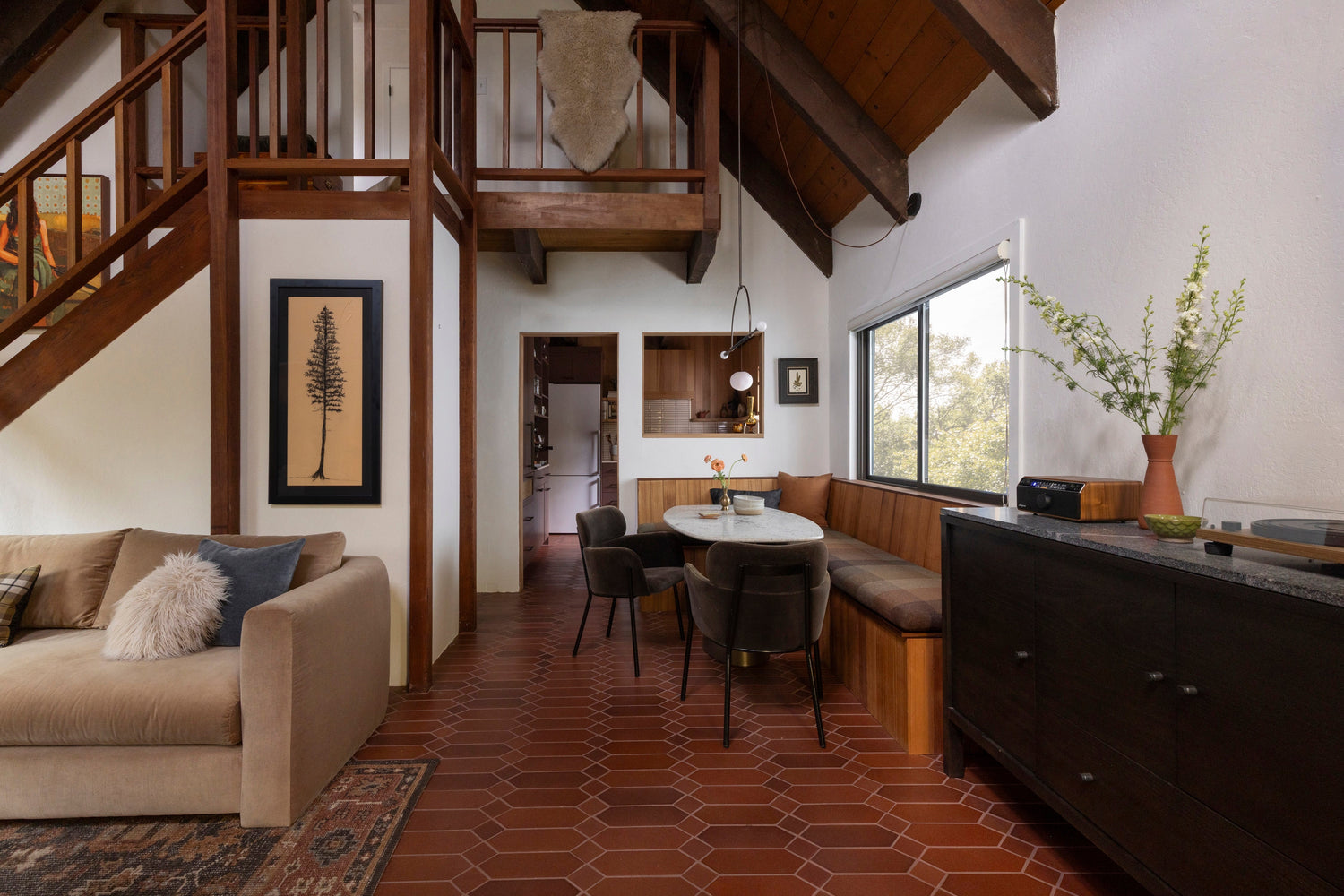
My house was built in 1978, so it's got some good '70s-era bones. The house itself is just shy of 1,200 square feet — three bed, two bath. I'm very lucky that none of the previous owners stripped or painted over any of the original charm. Nothing makes me sadder than walking into a home with incredible wood detailing that's been whitewashed.
Designing for Real Life
What was the overarching design vision?
I wanted to honor the era of the house — it's also an era that resonates with me aesthetically, which made it easy. Keeping tones warm and balancing the richer, darker colors was important. I am cabin vibes all day, every day, which fits both the house and the area, but I wanted to practice enough restraint that the design wouldn't feel thematic. I knew, having insider knowledge of everything coming down the pike at Fireclay, that there were some tile patterns and colors that would be a perfect fit for this project.
 Tile: 4x4 Sweet Pea Gloss, Lattice in Raven & Chaparral Matte | Bath: Foundry faucet and shower system in Architectural Copper with Pebble ceramic knobs in Tiger's Eye | Wall Finishes: Portola Paints | Vanity: Room & Board | Lighting: Hennepin Made | Design: Jamie Chappell | Image: SEN Creative
How does the home reflect your lifestyle?
This is a small house with no formal entry, and I live a very indoor/outdoor, kind of dirty life. I love to be outside in the woods or in my pottery studio, so between me and three animals traipsing in and out with dirt on our feet every day in all kinds of weather, ease of cleaning was paramount. You'll find a lot of easy-to-clean surfaces (hello, tile floors) and minimal soft floor coverings. I also use my woodstove as a primary heat source in the winter, so it plays a main character in everything and requires more interior space for wood inventory during the colder months.
How did you maximize the footprint of the kitchen and dining area?
I went back and forth on many options for kitchen cabinets and ultimately decided to have a local cabinet shop in Santa Cruz build custom cabinets and a custom banquette. They were a little pricier than something from a box store, but the storage is truly exceptional — every square inch has a purpose. With a small house, I was able to add ample storage while keeping the kitchen from feeling boxed in. For that reason, I highly recommend working with a local cabinetmaker as the default for a kitchen remodel.
I've known I wanted a banquette in the dining area from day one — partly to shrink the footprint of the dining area and make the space feel bigger, but also because I just love a good banquette. When my family visits, we all love playing games, and the banquette is honestly one of the spots everyone gravitates to. My sister and her family were recently here and there was space for all five of us to really stretch out. We spend a lot of time at that table.
 Tile: Mission Antique | Wall Finishes: Portola Paints (custom) | Light: Katy Skelton | Dining Table: Room & Board | Design: Jamie Chappell | Image: SEN Creative
What surprised you most throughout the renovation and design process?
How much Fireclay Design Services saved the day. I'm pretty good at visualizing, but this was a big project with a lot of details coming together. Our in-house rendering and creative services teams are incredible resources for homeowners and designers alike. I 100% had a "final" design three times before it was truly final — the ability to see the actual space rendered is incredibly powerful and makes decision-making so much easier.
How do you want people to feel when they walk through the space?
I hope anyone visiting feels like they can sit down and stay a while — that the house is rich and layered, but also unfussy and not precious. I never want anyone to feel bad if they leave a mark behind. I want people to feel comfortable being themselves, and in turn, feel like the space is a clear reflection of who I am.
 Tile: Mission Antique | Wall Finishes: Portola Paints (custom) | Side Chair: Room & Board, Rug: Room & Board, Sofa: Room & Board | Design: Jamie Chappell | Image: SEN Creative
A Material Meet-Cute
Favorite design detail?
This seems silly, and it truly is a detail, but there are a few places in the kitchen where tile transitions into cedar paneling, and at each of those transitions there's a small brass Schluter strip between materials that just feels extra special. It wasn't a functional choice — purely aesthetic — and I'm glad I did it.
 Tile: 1x1 & 1x6 Ivory Gloss | Cabinets: Oxford Designs (Custom)| Hardware: Plank | Design: Jamie Chappell | Image: SEN Creative
How did you approach materials, texture, and color?
I love materials. I began my career selling interior finish materials — including Fireclay Tile — for a green building retailer in Seattle. Thanks to that early exposure, I have a deep well of knowledge about different finish materials. Clay is my first love and always shows up, from tile to wall finishes to decor. With that in mind, I find that I chase materials that complement clay — things that feel natural and are authentic to what they are. I also think about materials you can truly live with, that will patina beautifully the more they're lived in.
The original materials in the home are very warm, and there's also a pretty wide range of wood species throughout the space. I wanted to keep all the wood — maybe even add a little more as paneling in the kitchen — while keeping the range of wood tones minimal.
 Tile: 1x1 & 1x6 Ivory Gloss | Cabinets: Oxford Designs (Custom)| Hardware: Plank | Design: Jamie Chappell | Image: SEN Creative
Truly, though, everything started in the bathroom. I knew I wanted that space to feel appropriate to the era of the house: warm and grounded, but also a little playful. As I was working out the material palette, we were finalizing many selections for our soon-to-launch Ceramic Floor Tile offering, which is when I fell in love with what would become our Lattice pattern. That was the first selection. From there, I knew I wanted the other colors in that space to feel lighter, since the floor was quite dark. Sweet Pea was a natural, warm, peachy pairing, and given the space is small and a little dark, I knew gloss was the right sheen to bounce as much natural light around as possible. I'm a big sucker for plaster finishes and also fairly experienced at installing them, so I knew Portola's Roman Clay would be the perfect complement to the wood and tile. As luck would have it, their Coda color is almost a perfect match to Sweet Pea. I wanted the floor to be the focal point in the bathroom, so I kept all the other colors very monochromatic to let the space feel quiet even with such a bold floor. This was also the very first install of Fireclay Bath, which was another focal point in the space. I wanted to stick with warm hues but infuse some contrast to make the bath fittings stand out.
 Tile: 4x4 Sweet Pea Gloss, Lattice in Raven & Chaparral Matte | Bath: Foundry shower system in Architectural Copper with Pebble ceramic knobs in Tiger's Eye | Wall Finishes: Portola Paints | Vanity: Room & Board | Design: Jamie Chappell | Image: SEN Creative
All the wood tones were a major influence in the floor tile decisions. There's a very large redwood-paneled wall in my living area with ceilings made of stained fir, and I ultimately decided I wanted the floor and the paneled wall to feel as though they were selected together. That led to the biggest decision: using Antique as the main floor color.
The kitchen cabinet color was a true happy accident. The original spec was for an earthy green, and I asked my painter to put a dark color on the wall before the cedar paneling went up — since the panels were butt-joined, I didn't want bright white shining through. I probably spent 30 seconds on the Dunn-Edwards website picking that color, and the second I laid eyes on it, I had to have it. I cannot imagine that kitchen any other color. It's dark and enveloping, which was exactly the vibe I was going for.
 Tile: Mission Antique, 1x4 & 1x6 Ivory Gloss + 1x4 & 1x6 Sweet Pea Gloss| Cabinets: Oxford Designs (Custom)| Hardware: Plank | Design: Jamie Chappell | Image: SEN Creative
The guest bedroom, just down the hall, has always been paneled in the same fir as the ceilings, and it's everyone's favorite room. I wanted that same layered, grounded feel throughout the house, so all the colors and textures were selected with that cabin vibe in mind.
Can you talk about the role vintage and art played in making the home feel personal and collected?
I have a variety of objects I've collected over the years. Most were made by family, like the birds my grandfather carved — they all have little stories to tell. I'm actually not a big vintage hunter; I like to ask people I love if I can have things from their spaces (ha!). I have coasters from a friend's grandmother's house because she had too many, and votive holders from a friend's wedding for the same reason. I have artwork painted by very talented friends and pots thrown by potters I admire. A framed bandanna from a Dolly Parton concert my sister and I surprised my mom with one year.
 Tile: Mission Antique, 3x3 Tiger's Eye | Wall Finishes: Portola Paints (custom) | Console: Room & Board, Rug: Room & Board, Sofa: Room & Board | Design: Jamie Chappell | Image: SEN Creative
Art is huge in my life — it always has been — and the art I love has to feel at home in my space and influences colors in many ways. I got into collecting prints from artists I love several years ago. I can't afford the real thing, but a well-framed print gets you 95% of the way there. I like to joke that I designed everything around FAFO, a Jeff Weir print that hangs in my stair.
One of the great things about getting older is that the small things you've collected along the way start to represent the many phases of your story and the people who've been part of those stories.
 Tile: 4x4 Sweet Pea Gloss | Bath: Foundry faucet in Architectural Copper with Pebble ceramic knobs in Tiger's Eye | Wall Finishes: Portola Paints | Vanity: Room & Board | Lighting: Hennepin Made | Design: Jamie Chappell | Image: SEN Creative
Behind the Scenes of Product Design
Being so deeply ingrained in Fireclay Tile through your role as VP of Brand and Product, how did that shape the way you approached using the product throughout your own home?
Ha! It gave me way too many options, that's for sure. I'd be lying if I said some of the product we recently launched wasn't "edited" to fit this real-world little incubator before finalizing details. The thing that was actually most interesting to watch and learn from was the installation itself. We have the best installers, hands down, and hearing their questions and learning more about what was easy or hard informed some of the way we thought about sheeting patterns, trims, and even product pricing.
 Jamie at the Innovation Lab in our Aromas, CA factory
You've been with Fireclay for 13 years — how has your role evolved over time? What does a typical day look like for you now?
In recent years we've been able to narrow my focus as the company has grown. My passions are product, manufacturing, and brand, so today I oversee product development and merchandising as well as brand marketing and showroom development.
No two days are alike at Fireclay, which works for me — I appreciate change and problem-solving on the fly. I try to break my weeks into more intentional areas of focus as much as possible. Mondays I tackle as much admin as possible, including most one-on-ones with my direct reports and connecting with fellow leadership teammates. Tuesdays I focus on showroom design and development — anything from initial store layouts to finish selections to merchandising, involving a lot of collaboration with architects and contractors. Wednesday through Friday, my goal is always product, product, product. That can include evaluating the performance of recent launches, running through the discovery process for anything we're considering adding to the portfolio, working hands-on with our production teams on anything in R&D, and coordinating with e-comm, sales, and marketing on launching new products in the queue.
You're deeply connected to the people and processes at the Aromas factory. How did that behind-the-scenes knowledge inform the way you approached your home renovation?
I try as much as I can to think about ease of production and ease of installation. I probably thought far more about the install side of things than the production side during my home renovation, and I also learned a lot from our install team as the project was happening. Our production teams are so skilled at this point — by the time something goes into production, we're very good at making it, and they only get faster as we work through actual orders.
 Jamie and Production Manager Fernando Menchaca Ortiz in our Aromas, CA factory
I did have a few advantages in working through final details with production that ultimately benefit our customers. Lattice, the pattern on my bathroom floor, for example — I really wanted as consistent and narrow a grout grid as possible, knowing that the grout in that pattern is such a big part of the overall repeat. I was able to go rounds with production, dry-laying tile on my bathroom floor, to get our sheeting grids just right. The result of that collaboration is what's now available for any Fireclay customer to enjoy.
The Selections Jamie Shaped
You actually sculpted the forms for the ceramic Pebble knobs in your home studio. What was the process of taking those from concept to finished product? And how does it feel to have those forms in your guest bath?
When we launched Fireclay Bath, we knew we had to bridge the gap of what makes this a Fireclay product. I worked very closely with Avi Abel, who leads Fireclay Bath, and our production teams to think through how we — as makers of flat clay things — could become makers of dimensional clay things. We had a fairly easy-to-borrow form for testing from our manufacturing partner; that became the Groove knob, which would have been great on its own. Full disclosure: I'm one of those potters who hates glazing. I keep it simple and prefer to throw forms that allow a glaze to bend and break over intricate surface decoration. With Groove, we were able to achieve a really beautiful glaze break on a form that feels very contemporary.
 Tile: 4x4 Sweet Pea Gloss | Bath: Foundry shower system in Architectural Copper with Pebble ceramic knobs in Tiger's Eye | Design: Jamie Chappell | Image: SEN Creative
I felt like we needed a complement to that style — something a little more feminine that would highlight a different characteristic of glaze: pooling. I think I first sketched an idea on a whiteboard in the office, and our ceramic engineer, who knows my clay habits, said, "Why don't you just throw it?" Mission accepted. That gave me the ability to sketch my idea in clay, which our production teams understand better than any drawing. From there we built a 3D model and a mold, and the rest is history.
It's very humbling to use in my home a product I designed in my little shed that we're now manufacturing at scale — which was never on my punch card. It also lets me better imagine how our customers are using the product and how they might feel turning one of those little ceramic knobs every day, which I really hope brings people so much joy. And most importantly, it gives me so many more ideas.
The Tiger's Eye Studio Glaze behind your wood stove has incredible depth. Can you share what went into developing a glaze like that?
My challenge to production was to think like a potter — use more earthen and reactive materials that mature slowly when fired. I'm a sucker for iron oxides, which showed up a lot as they were experimenting. Our director of innovation at the time gave one of our newer teammates an open-ended task to just mess around, and one day he brought this glaze up to me and I knew we had to have it. It's very simple in its formulation, a little temperamental in the firing, but it has the most insane glassy, rich red-brown depth. It truly changes personality throughout the day depending on where the natural light is falling in the space.
 Tile: Mission Antique, 3x3 Tiger's Eye | Design: Jamie Chappell | Image: SEN Creative
What do you love about ceramic underfoot in the living spaces of your home?
Growing up, I used to fight with my mom about wearing shoes. I've been a barefoot person my entire life, especially at home. The most surprising thing about a ceramic tile floor under bare feet is how good the material actually feels — so much softer underfoot than I think anyone would expect. It's also amazing at radiating warmth. My house is oriented in such a way that winter sun shines in and warms the floors during the day, and you feel that warmth for quite a while after the sun goes down. The tile near my woodstove never gets too hot — it's so radiantly warm that I have a cat who wedges herself between the tile floor and the splashback behind the stove.
I also have radiant heat in the bathroom and kitchen, which I cannot recommend enough. Ceramic tile is also wildly easy to clean. If the dog runs in with muddy paws, a little damp mop and we're good as new. I typically just vacuum and do a damp mop once a week, and I've got a house full of animals. I've also learned that Murphy's Oil Soap is a truly fabulous cleaner for ceramic tile floors — it restores the rich luster of our ceramic stains and helps repel dust.
 Tile: Mission Antique | Wall Finishes: Portola Paints (custom) | Light: Katy Skelton | Dining Table: Room & Board, Console: Room & Board | Design: Jamie Chappell | Image: SEN Creative
After seeing your vision come to life, what is exciting you most right now about the future of what we can create at Fireclay?
Oh man — the thing we've learned with the launch of Fireclay Bath, and the truly incredible reception from our trade clients and homeowners alike, is that we can do other things too. The big dream is to find ways to continue building on that momentum, though of course that will never come at the expense of what we do best, which is tile. Right now we're reimagining our Handpainted offering, thinking of ways to really update that program and give designers more flexibility to incorporate that product into their work. We're planning to debut it this fall at BDNY.

Feeling inspired by Jamie's beautiful home? Book a free design consultation to get your own project started.